
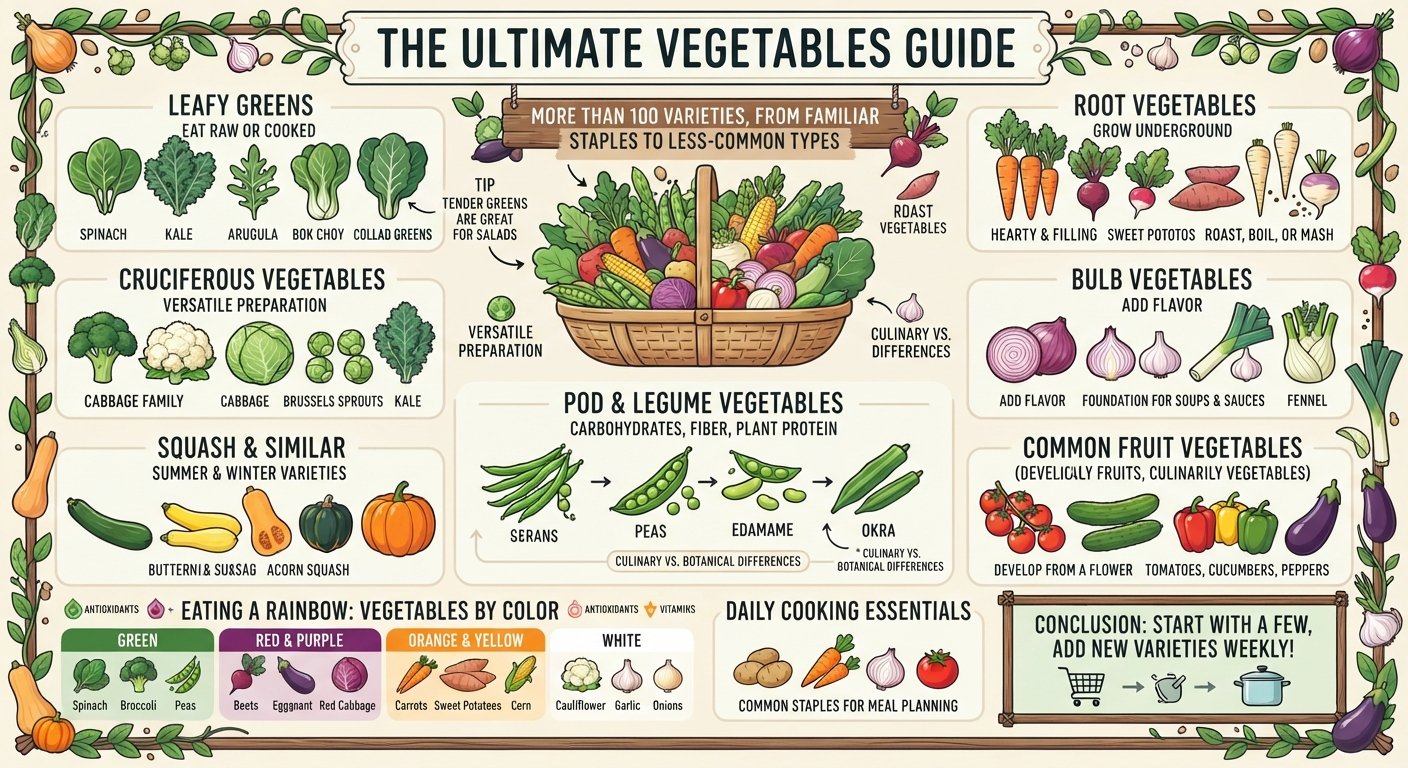
Vegetables come in many shapes, colors, flavors, and varieties, from familiar carrots and potatoes to bok choy, fennel, artichokes, and watercress. This vegetables list includes more than 100 common and less-common vegetables organized into useful categories. You’ll find leafy greens, root vegetables, cruciferous vegetables, bulbs, stems, pods, and other edible plant foods. Whether you need vegetables for meal planning, a grocery list, gardening, or general nutrition, this guide gives you an easy reference to start with.
Quick Answer: Common vegetables include carrots, potatoes, onions, tomatoes, spinach, broccoli, cauliflower, cabbage, cucumber, bell peppers, peas, green beans, eggplant, zucchini, radishes, beets, and sweet potatoes. Vegetables can also be grouped into categories such as leafy greens, roots, bulbs, stems, cruciferous vegetables, and legumes.
Complete Vegetables List
Here is a broad list of vegetables arranged alphabetically for easy reference.
| Vegetable | Category |
|---|---|
| Artichoke | Flower vegetable |
| Arugula | Leafy green |
| Asparagus | Stem vegetable |
| Beetroot | Root vegetable |
| Bell pepper | Fruit vegetable |
| Bok choy | Cruciferous |
| Broccoli | Cruciferous |
| Brussels sprouts | Cruciferous |
| Cabbage | Cruciferous |
| Carrot | Root vegetable |
| Cauliflower | Cruciferous |
| Celery | Stem vegetable |
| Chard | Leafy green |
| Collard greens | Leafy green |
| Corn | Grain/vegetable |
| Cucumber | Fruit vegetable |
| Daikon | Root vegetable |
| Eggplant | Fruit vegetable |
| Fennel | Bulb vegetable |
| Garlic | Bulb |
| Green beans | Pod vegetable |
| Kale | Leafy green |
| Kohlrabi | Stem vegetable |
| Leek | Bulb/stem |
| Lettuce | Leafy green |
| Mushroom | Edible fungus |
| Mustard greens | Leafy green |
| Okra | Pod vegetable |
| Onion | Bulb |
| Parsnip | Root vegetable |
| Peas | Legume |
| Potato | Tuber |
| Pumpkin | Squash |
| Radish | Root vegetable |
| Rutabaga | Root vegetable |
| Spinach | Leafy green |
| Sweet potato | Root/tuber |
| Swiss chard | Leafy green |
| Turnip | Root vegetable |
| Watercress | Leafy green |
| Zucchini | Summer squash |
This table provides a starting point, but there are many more vegetables worth knowing.
1. Leafy Green Vegetables
Leafy greens are among the easiest vegetables to add to everyday meals. They can be eaten raw in salads, cooked into curries and soups, or blended into smoothies.
Common leafy greens
- Spinach
- Kale
- Lettuce
- Romaine lettuce
- Arugula
- Swiss chard
- Collard greens
- Mustard greens
- Turnip greens
- Beet greens
- Watercress
- Bok choy
- Tatsoi
- Mizuna
- Endive
- Escarole
- Radicchio
- Sorrel
Practical tip: Tender greens such as spinach and arugula work well raw, while tougher greens such as collards and mature kale are often better cooked.
2. Root Vegetables
Root vegetables grow underground and are often naturally hearty and filling.
Root vegetable list
- Carrots
- Beets
- Radishes
- Turnips
- Parsnips
- Rutabagas
- Daikon
- Celeriac
- Jicama
- Salsify
- Horseradish
- Burdock root
- Cassava
- Sweet potatoes
Root vegetables can be roasted, boiled, mashed, steamed, or added to soups and stews.
Carrots, for example, can be eaten raw as a snack, while parsnips develop a sweeter flavor when roasted.
3. Cruciferous Vegetables
Cruciferous vegetables belong to the cabbage family and include some of the most recognizable vegetables in supermarkets.
Examples include:
- Broccoli
- Cauliflower
- Cabbage
- Brussels sprouts
- Kale
- Bok choy
- Kohlrabi
- Broccoli rabe
- Napa cabbage
- Mustard greens
- Collard greens
- Watercress
- Radishes
These vegetables can be prepared in many ways. Broccoli can be steamed or roasted, cabbage can be fermented or stir-fried, and cauliflower can be roasted, steamed, or incorporated into soups.
4. Bulb Vegetables
Bulb vegetables are particularly useful for adding flavor to meals.
Bulb vegetable list
- Onions
- Garlic
- Shallots
- Leeks
- Fennel
- Spring onions
- Scallions
Onions and garlic are common foundations for soups, sauces, curries, stir-fries, and countless other dishes.
Leeks have a milder flavor and are particularly popular in soups. Fennel has a distinctive slightly sweet, anise-like flavor and can be eaten raw or cooked.
5. Stem Vegetables
Some vegetables are valued primarily for their edible stems.
Examples include:
- Asparagus
- Celery
- Rhubarb
- Kohlrabi
- Bamboo shoots
- Fiddlehead ferns
- Cardoon
Asparagus can be grilled, roasted, steamed, or sautéed. Celery is commonly eaten raw or used as an aromatic ingredient in soups and stews.
6. Pod and Legume Vegetables
Pods and immature legumes are another useful group.
Examples:
- Green beans
- Peas
- Snow peas
- Sugar snap peas
- Edamame
- Okra
- Yardlong beans
- Broad beans
- Lima beans
Peas and beans can provide carbohydrates, fiber, and plant protein. Their nutritional composition varies depending on the specific vegetable and whether it is eaten fresh, dried, or processed.
Important distinction: Botanically, many foods commonly called vegetables are actually fruits or seeds. Culinary classifications often differ from botanical classifications.
7. Squash and Similar Vegetables
Squash comes in many shapes and varieties.
Popular examples:
- Zucchini
- Yellow squash
- Butternut squash
- Acorn squash
- Spaghetti squash
- Delicata squash
- Kabocha squash
- Pumpkin
- Pattypan squash
Summer squash such as zucchini generally has a softer texture and shorter cooking time. Winter squash tend to have firmer flesh and can be stored for longer.
8. Common Fruit Vegetables
Some foods are botanically fruits but are commonly treated as vegetables in cooking.
Examples include:
- Tomatoes
- Cucumbers
- Bell peppers
- Chili peppers
- Eggplant
- Zucchini
- Pumpkin
- Okra
- Squash
This distinction is useful when researching vegetables because a food’s botanical classification does not always match its culinary classification.
For example, a tomato develops from a flower and contains seeds, so botanically it is a fruit. In the kitchen, however, it is usually treated as a vegetable.
9. Vegetables by Color
Color can be a convenient way to make meals more visually appealing and increase variety.
Green vegetables
- Spinach
- Broccoli
- Kale
- Green beans
- Peas
- Zucchini
- Cucumber
- Asparagus
- Brussels sprouts
Red and purple vegetables
- Red cabbage
- Red bell peppers
- Beets
- Purple carrots
- Purple cauliflower
- Eggplant
- Radicchio
Orange and yellow vegetables
- Carrots
- Pumpkin
- Sweet potatoes
- Yellow squash
- Yellow bell peppers
- Corn
White vegetables
- Cauliflower
- Garlic
- Onions
- Turnips
- Parsnips
- Daikon
- Mushrooms
Eating a range of colors can make meals more varied and introduce different naturally occurring plant compounds.
10. Common Vegetables for Everyday Cooking
If you simply want a practical grocery-store vegetables list, start with these staples:
- Potatoes
- Carrots
- Onions
- Tomatoes
- Spinach
- Broccoli
- Cauliflower
- Cabbage
- Bell peppers
- Cucumbers
- Green beans
- Peas
- Garlic
- Sweet potatoes
- Zucchini
- Eggplant
- Lettuce
- Radishes
- Corn
- Mushrooms
These vegetables are versatile enough for salads, soups, roasted dishes, stir-fries, curries, sandwiches, and side dishes.
11. Nutritious Vegetables to Add to Your Diet
There is no single vegetable that provides every nutrient your body needs. Variety is more useful than relying on one “super vegetable.”
Some particularly nutrient-dense choices include:
Spinach
Spinach provides folate, vitamin K, vitamin A precursors, and other nutrients. It can be added to omelets, soups, curries, pasta, and salads.
Broccoli
Broccoli provides vitamin C, vitamin K, folate, fiber, and other plant compounds.
Carrots
Carrots are particularly known for beta-carotene, which the body can convert to vitamin A.
Sweet Potatoes
Sweet potatoes provide carbohydrates, fiber, potassium, and carotenoids, with the exact nutritional profile varying by variety.
Bell Peppers
Bell peppers are available in several colors and can be eaten raw, grilled, roasted, or sautéed.
Cabbage
Cabbage is inexpensive, versatile, and stores relatively well. It can be used in salads, stir-fries, soups, wraps, and fermented preparations.
How Many Vegetables Should You Eat?
The ideal amount depends on factors such as age, energy needs, overall diet, and individual health requirements.
Rather than concentrating on a single number, focus on making vegetables a regular part of meals and varying the types you eat.
A practical approach is to:
- Include vegetables with lunch and dinner.
- Rotate between leafy greens, roots, cruciferous vegetables, and other varieties.
- Choose different colors throughout the week.
- Use fresh, frozen, and canned vegetables according to convenience and availability.
- Prefer preparations that do not add excessive amounts of salt, sugar, or saturated fat.
Frozen vegetables can also be a convenient choice. They can reduce food waste and make it easier to keep vegetables available when fresh produce is not convenient.
Fresh, Frozen, or Canned Vegetables?
Each option can have a place in a healthy eating pattern.
| Type | Main Advantage | What to Check |
|---|---|---|
| Fresh | Texture and variety | Freshness and storage life |
| Frozen | Convenient and long-lasting | Added sauces or salt |
| Canned | Easy to store | Sodium and added ingredients |
| Dried | Long shelf life | Preparation requirements |
When buying canned vegetables, checking the nutrition label can help you identify products with less added sodium. Rinsing certain canned vegetables can also reduce some of the sodium.
Easy Ways to Eat More Vegetables
Adding more vegetables does not require completely changing your diet.
Try these simple strategies:
- Add spinach to eggs or sandwiches.
- Put sliced vegetables beside lunch.
- Add carrots, peas, or beans to soups.
- Roast a tray of mixed vegetables for several meals.
- Keep washed vegetables ready for snacks.
- Add mushrooms, peppers, or zucchini to pasta.
- Use cabbage or lettuce in wraps.
- Add extra vegetables to curries and stir-fries.
- Mix different vegetables into rice or grain dishes.
The easiest vegetable to eat is often the one you already have prepared.
Frequently Asked Questions
What are the 20 most common vegetables?
Twenty widely used vegetables include potatoes, carrots, onions, tomatoes, spinach, broccoli, cauliflower, cabbage, cucumber, bell peppers, peas, green beans, lettuce, garlic, sweet potatoes, zucchini, eggplant, corn, radishes, and mushrooms.
What are the different types of vegetables?
Vegetables can be grouped in several ways, including leafy greens, roots, tubers, bulbs, stems, cruciferous vegetables, pods, legumes, and squash. Culinary and botanical classifications can sometimes differ.
Which vegetables are healthiest to eat?
There is no single “healthiest” vegetable for everyone. A varied diet containing leafy greens, cruciferous vegetables, colorful vegetables, roots, and other plant foods provides a broader range of nutrients and plant compounds.
What vegetables should I eat every day?
Try to include a variety rather than eating exactly the same vegetables every day. Leafy greens, broccoli, carrots, peppers, cabbage, tomatoes, and other seasonal vegetables can all contribute to a varied diet.
What vegetables are considered root vegetables?
Common root vegetables include carrots, beets, radishes, turnips, parsnips, rutabagas, daikon, and celeriac. Sweet potatoes and potatoes are underground storage organs but are botanically classified differently from true roots.
Conclusion
This vegetables list shows just how much variety exists beyond the basic supermarket staples. From leafy greens and cruciferous vegetables to roots, bulbs, pods, squash, and colorful culinary vegetables, there are hundreds of ways to build more variety into meals.
You don’t need to buy every type at once. Start with a few familiar vegetables, add one new variety each week, and experiment with different cooking methods.
