
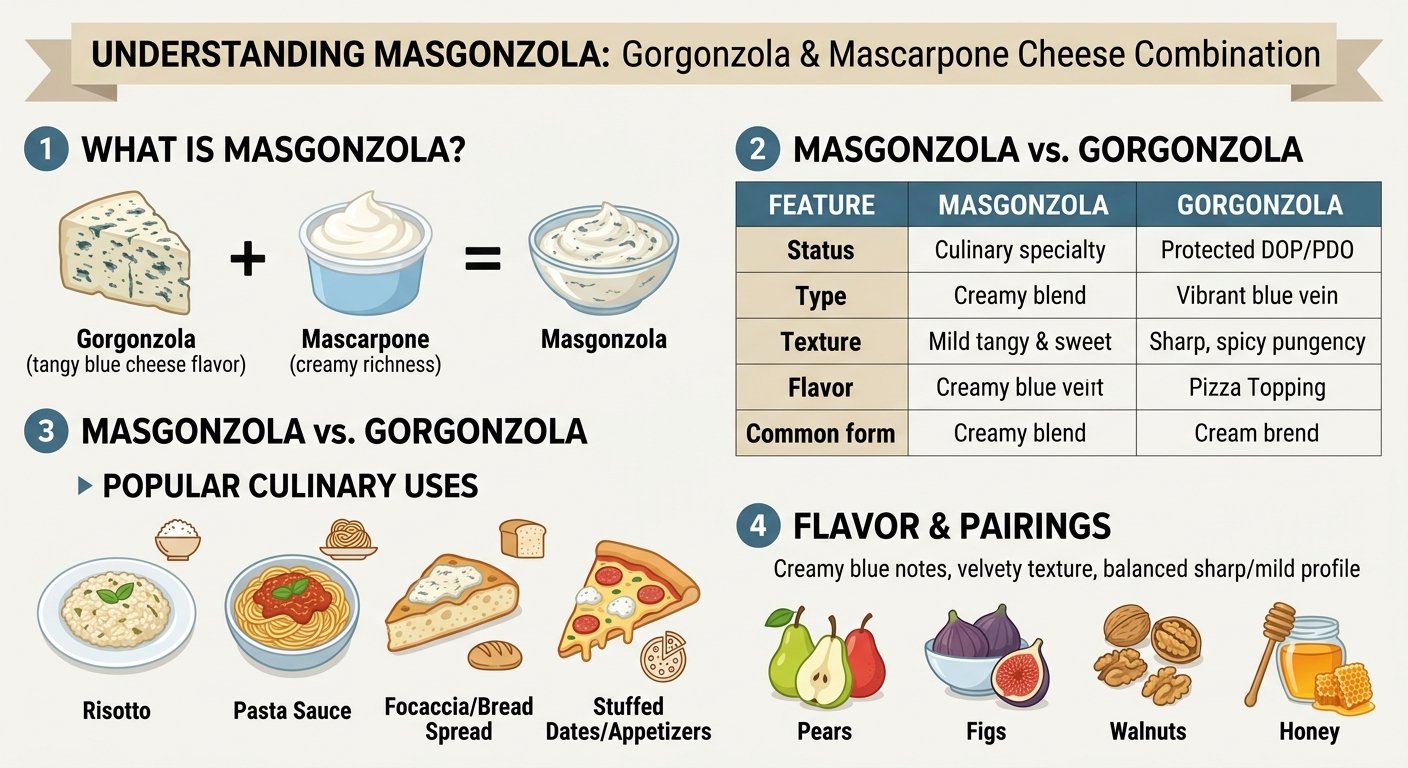
If you have searched for Masgonzola and wondered whether it is a traditional Italian cheese, the answer is more nuanced than the name suggests. Masgonzola is used as a name for a combination of Gorgonzola and mascarpone, bringing together blue cheese flavor and a rich, creamy texture. Betty Bossi explicitly identifies Masgonzola as “Mascarpone-Gorgonzola” in published recipes, including a risotto where it can replace separate Gorgonzola and mascarpone.
Quick Answer
Masgonzola is a Gorgonzola-and-mascarpone cheese combination or specialty. Gorgonzola supplies the salty, tangy blue-cheese character, while mascarpone contributes softness, richness, and creaminess. It can be spread on bread, stirred into risotto or pasta, used on pizza, or served with fruit and nuts.
Importantly, Masgonzola should not automatically be treated as a separate protected cheese designation equivalent to Gorgonzola PDO. Gorgonzola itself has protected status and is regulated by its consortium; the evidence for Masgonzola instead points to a culinary or commercial combination.
What Is Masgonzola?
Masgonzola is best understood as a Gorgonzola and mascarpone preparation.
The two ingredients bring very different characteristics to the finished product:
| Ingredient | What it contributes |
|---|---|
| Gorgonzola | Tangy, salty, savory blue-cheese flavor |
| Mascarpone | Mild taste, richness, softness and creaminess |
| Masgonzola | A smoother combination of both |
The term is particularly well documented in recipes. Betty Bossi lists “Masgonzola (Mascarpone-Gorgonzola)” as an ingredient in its stuffed-date recipe and uses the combination in other dishes as well.
Commercial cheese producers also make products based on the same pairing. For example, Italian producer casArrigoni describes its Gorgonzola & Mascarpone as a cheese preparation consisting of alternating layers of mascarpone and Gorgonzola Dolce.
That distinction is useful because you may encounter the product without seeing the word “Masgonzola” on the package.
It may instead be labeled:
- Gorgonzola & Mascarpone
- Gorgonzola e Mascarpone
- Gorgonzola with Mascarpone
- Gorgonzola-Mascarpone
In other words, the combination matters more than the exact marketing name.
Why Is It Called Masgonzola?
The name appears to be a straightforward combination of the two underlying cheese names:
Mascarpone + Gorgonzola = Masgonzola
That explanation also fits the way Betty Bossi uses the term, directly defining it as Mascarpone-Gorgonzola.
There is, however, an important SEO and factual distinction to make.
It would be misleading to present Masgonzola as an ancient, independently protected Italian cheese with a universally standardized recipe unless reliable evidence establishes those claims.
The documented evidence is much simpler: the word is used in recipes for a Gorgonzola-mascarpone combination, and similar combinations are commercially produced.
Is Masgonzola a Real Cheese?
The food combination is real, and the term has documented culinary use.
Betty Bossi provides particularly strong evidence because its recipe database does not merely mention the word in an article about Masgonzola. It actually uses Masgonzola as an ingredient and defines it as Mascarpone-Gorgonzola.
There is also direct producer evidence for the underlying product. casArrigoni describes Gorgonzola and mascarpone layered together as a cheese preparation, while another Italian producer lists a layered cheese containing mascarpone and Gorgonzola PDO.
But is it a protected cheese?
This is where the answer changes.
Gorgonzola is a protected Italian PDO/DOP cheese. The official Gorgonzola Consortium states that Gorgonzola is recognized by the European Union and registered as a DOP product. Its production and use of the protected name are subject to specific controls.
The evidence reviewed does not establish a separate Masgonzola PDO/DOP designation.
Therefore, it is more accurate to describe Masgonzola as a cheese combination or specialty involving Gorgonzola and mascarpone, rather than as another independently protected Italian cheese category.
What Does Masgonzola Taste Like?
The easiest way to understand the flavor is to consider what happens when the two components meet.
Gorgonzola brings intensity
Gorgonzola is a blue-veined Italian cheese with a distinctive savory, tangy flavor. Depending on the particular Gorgonzola, the experience can range from relatively mild and creamy to considerably stronger.
Mascarpone adds softness
Mascarpone is much milder and contributes a rich, smooth texture.
When combined, the mascarpone can make the blue-cheese character feel rounder and creamier rather than delivering the full intensity of Gorgonzola on its own.
The exact result depends on the recipe or commercial product because there is no single universal Masgonzola formula.
That means two products sold as Gorgonzola-and-mascarpone combinations can differ in:
- Cheese ratio
- Saltiness
- Blue-cheese intensity
- Texture
- Appearance
- Spreadability
One documented commercial example, for instance, specifies alternating layers rather than simply blending the cheeses into a completely uniform mixture.
Masgonzola vs. Gorgonzola
The names are similar, but the foods should not be treated as identical.
| Feature | Masgonzola | Gorgonzola |
|---|---|---|
| Main composition | Gorgonzola + mascarpone | Gorgonzola |
| Texture | Usually softer and creamier | Varies by style |
| Flavor | Blue-cheese flavor moderated by mascarpone | More directly blue-cheese focused |
| Use | Spreads, sauces, risotto, appetizers | Cheese boards, sauces, pasta, risotto and more |
| Protected designation | No separate Masgonzola designation established in the sources reviewed | EU-protected DOP/PDO |
| Naming | May also appear as Gorgonzola & Mascarpone | Gorgonzola |
The official Gorgonzola Consortium confirms the protected status of Gorgonzola, while commercial producers demonstrate that Gorgonzola can also be combined with mascarpone into separate preparations.
How to Use Masgonzola in Cooking
Masgonzola is particularly useful where you want both creaminess and blue-cheese flavor.
1. Stir It Into Risotto
This is one of the clearest documented applications.
Betty Bossi’s Gorgonzola risotto combines Gorgonzola and mascarpone and specifically suggests 200 g of Masgonzola as a substitute for the two ingredients separately.
For best results:
- Cook the risotto until the rice is creamy and al dente.
- Add the Masgonzola near the end.
- Stir until incorporated.
- Taste before adding extra salt.
- Serve immediately.
The cheese should enrich the risotto without overpowering its texture.
2. Spread It on Focaccia or Bread
Its soft consistency makes Masgonzola especially practical as a spread.
Betty Bossi’s focaccia recipe specifically gives a Masgonzola version, recommending approximately 200 g of Masgonzola spread inside the bread.
For a simple serving, pair it with:
- Rocket/arugula
- Pear
- Walnuts
- Fresh figs
- Honey
- Roasted vegetables
Sweet and fresh ingredients can provide useful contrast to the cheese’s richness.
3. Make a Creamy Pasta Sauce
Masgonzola can melt into hot pasta and form the foundation of a rich sauce.
A practical approach is to combine it with a little pasta water rather than automatically adding large quantities of cream. The starchy water helps loosen the cheese and coat the pasta.
Good pairings include:
- Gnocchi
- Pappardelle
- Penne
- Ravioli
- Mushrooms
- Spinach
- Walnuts
- Black pepper
Because Masgonzola is already rich, a relatively small quantity can have a noticeable effect.
4. Use It in Appetizers
One documented Betty Bossi preparation uses Masgonzola mixed with milk and piped into dates, then garnished with walnuts and rocket.
This works because the sweet dates provide a strong contrast to the salty, savory cheese.
You can apply the same principle to:
- Crostini
- Crackers
- Stuffed figs
- Endive leaves
- Toasted baguette
- Pear slices
5. Try It on Pizza or Flatbread
Masgonzola can also work as a topping.
Use it with ingredients that complement rich blue cheese, such as:
- Pear
- Mushroom
- Onion
- Spinach
- Walnut
- Fig
A little goes a long way, particularly when other rich ingredients are already present.
Can You Make Masgonzola at Home?
You can recreate the basic Gorgonzola-mascarpone combination at home, although the result should not automatically be presented as an officially standardized Masgonzola cheese.
A simple version requires:
- Gorgonzola Dolce
- Mascarpone
For a layered preparation, one documented commercial product uses alternating layers of the two cheeses, while home recipes demonstrate similar layered combinations.
For a simple serving-size experiment, start with approximately equal quantities of the two cheeses and adjust the ratio according to taste.
Want a stronger blue-cheese flavor?
Increase the Gorgonzola.
Want a milder, creamier result?
Increase the mascarpone.
The important point is that this homemade mixture is a culinary preparation, not necessarily the same standardized product as every commercial Gorgonzola-mascarpone cheese.
What Should You Pair With Masgonzola?
Masgonzola’s richness makes contrast especially useful.
Sweet pairings
- Pear
- Fig
- Dates
- Apple
- Honey
- Grapes
Crunchy pairings
- Walnuts
- Hazelnuts
- Almonds
- Toasted bread
- Crackers
Savory pairings
- Mushrooms
- Spinach
- Caramelized onion
- Potato
- Pumpkin
- Pasta
For a cheese board, a combination of Masgonzola, pear, walnuts and crusty bread gives you creamy, salty, sweet and crunchy elements in one plate.
What Should You Look for When Buying It?
Because the name may not appear consistently on packaging, search for the underlying description rather than relying exclusively on the keyword “Masgonzola.”
Look for terms such as:
“Gorgonzola & Mascarpone” or “Gorgonzola e Mascarpone.”
Check the ingredient list and storage instructions, particularly if you’re comparing different products.
A producer’s product specification can also reveal the proportion of mascarpone to Gorgonzola. For example, an Arrigoni product sheet describes a preparation containing 60% mascarpone and 40% Gorgonzola, demonstrating how substantially a particular formulation can lean toward creaminess.
This is one reason it is better not to assume that every Masgonzola-style product will taste exactly the same.
Frequently Asked Questions
Is Masgonzola the same as Gorgonzola?
No. Masgonzola generally refers to a combination of Gorgonzola and mascarpone, whereas Gorgonzola is the established Italian blue-veined cheese with protected DOP/PDO status.
Is Masgonzola a real cheese?
The combination is real and the term has documented culinary use. Betty Bossi explicitly identifies Masgonzola as Mascarpone-Gorgonzola in its recipes.
What is Masgonzola made of?
Meta description: Discover what Masgonzola is, how mascarpone and Gorgonzola create its creamy flavor, how it compares with blue cheese, and how to use it.
If you have searched for Masgonzola and wondered whether it is a traditional Italian cheese, the answer is more nuanced than the name suggests. Masgonzola is used as a name for a combination of Gorgonzola and mascarpone, bringing together blue cheese flavor and a rich, creamy texture. Betty Bossi explicitly identifies Masgonzola as “Mascarpone-Gorgonzola” in published recipes, including a risotto where it can replace separate Gorgonzola and mascarpone.
Quick Answer
Masgonzola is a Gorgonzola-and-mascarpone cheese combination or specialty. Gorgonzola supplies the salty, tangy blue-cheese character, while mascarpone contributes softness, richness, and creaminess. It can be spread on bread, stirred into risotto or pasta, used on pizza, or served with fruit and nuts.
Importantly, Masgonzola should not automatically be treated as a separate protected cheese designation equivalent to Gorgonzola PDO. Gorgonzola itself has protected status and is regulated by its consortium; the evidence for Masgonzola instead points to a culinary or commercial combination.
What Is Masgonzola?
Masgonzola is best understood as a Gorgonzola and mascarpone preparation.
The two ingredients bring very different characteristics to the finished product:
| Ingredient | What it contributes |
|---|---|
| Gorgonzola | Tangy, salty, savory blue-cheese flavor |
| Mascarpone | Mild taste, richness, softness and creaminess |
| Masgonzola | A smoother combination of both |
The term is particularly well documented in recipes. Betty Bossi lists “Masgonzola (Mascarpone-Gorgonzola)” as an ingredient in its stuffed-date recipe and uses the combination in other dishes as well.
Commercial cheese producers also make products based on the same pairing. For example, Italian producer casArrigoni describes its Gorgonzola & Mascarpone as a cheese preparation consisting of alternating layers of mascarpone and Gorgonzola Dolce.
That distinction is useful because you may encounter the product without seeing the word “Masgonzola” on the package.
It may instead be labeled:
- Gorgonzola & Mascarpone
- Gorgonzola e Mascarpone
- Gorgonzola with Mascarpone
- Gorgonzola-Mascarpone
In other words, the combination matters more than the exact marketing name.
Why Is It Called Masgonzola?
The name appears to be a straightforward combination of the two underlying cheese names:
Mascarpone + Gorgonzola = Masgonzola
That explanation also fits the way Betty Bossi uses the term, directly defining it as Mascarpone-Gorgonzola.
There is, however, an important SEO and factual distinction to make.
It would be misleading to present Masgonzola as an ancient, independently protected Italian cheese with a universally standardized recipe unless reliable evidence establishes those claims.
The documented evidence is much simpler: the word is used in recipes for a Gorgonzola-mascarpone combination, and similar combinations are commercially produced.
Is Masgonzola a Real Cheese?
The food combination is real, and the term has documented culinary use.
Betty Bossi provides particularly strong evidence because its recipe database does not merely mention the word in an article about Masgonzola. It actually uses Masgonzola as an ingredient and defines it as Mascarpone-Gorgonzola.
There is also direct producer evidence for the underlying product. casArrigoni describes Gorgonzola and mascarpone layered together as a cheese preparation, while another Italian producer lists a layered cheese containing mascarpone and Gorgonzola PDO.
But is it a protected cheese?
This is where the answer changes.
Gorgonzola is a protected Italian PDO/DOP cheese. The official Gorgonzola Consortium states that Gorgonzola is recognized by the European Union and registered as a DOP product. Its production and use of the protected name are subject to specific controls.
The evidence reviewed does not establish a separate Masgonzola PDO/DOP designation.
Therefore, it is more accurate to describe Masgonzola as a cheese combination or specialty involving Gorgonzola and mascarpone, rather than as another independently protected Italian cheese category.
What Does Masgonzola Taste Like?
The easiest way to understand the flavor is to consider what happens when the two components meet.
Gorgonzola brings intensity
Gorgonzola is a blue-veined Italian cheese with a distinctive savory, tangy flavor. Depending on the particular Gorgonzola, the experience can range from relatively mild and creamy to considerably stronger.
Mascarpone adds softness
Mascarpone is much milder and contributes a rich, smooth texture.
When combined, the mascarpone can make the blue-cheese character feel rounder and creamier rather than delivering the full intensity of Gorgonzola on its own.
The exact result depends on the recipe or commercial product because there is no single universal Masgonzola formula.
That means two products sold as Gorgonzola-and-mascarpone combinations can differ in:
- Cheese ratio
- Saltiness
- Blue-cheese intensity
- Texture
- Appearance
- Spreadability
One documented commercial example, for instance, specifies alternating layers rather than simply blending the cheeses into a completely uniform mixture.
Masgonzola vs. Gorgonzola
The names are similar, but the foods should not be treated as identical.
| Feature | Masgonzola | Gorgonzola |
|---|---|---|
| Main composition | Gorgonzola + mascarpone | Gorgonzola |
| Texture | Usually softer and creamier | Varies by style |
| Flavor | Blue-cheese flavor moderated by mascarpone | More directly blue-cheese focused |
| Use | Spreads, sauces, risotto, appetizers | Cheese boards, sauces, pasta, risotto and more |
| Protected designation | No separate Masgonzola designation established in the sources reviewed | EU-protected DOP/PDO |
| Naming | May also appear as Gorgonzola & Mascarpone | Gorgonzola |
The official Gorgonzola Consortium confirms the protected status of Gorgonzola, while commercial producers demonstrate that Gorgonzola can also be combined with mascarpone into separate preparations.
How to Use Masgonzola in Cooking
Masgonzola is particularly useful where you want both creaminess and blue-cheese flavor.
1. Stir It Into Risotto
This is one of the clearest documented applications.
Betty Bossi’s Gorgonzola risotto combines Gorgonzola and mascarpone and specifically suggests 200 g of Masgonzola as a substitute for the two ingredients separately.
For best results:
- Cook the risotto until the rice is creamy and al dente.
- Add the Masgonzola near the end.
- Stir until incorporated.
- Taste before adding extra salt.
- Serve immediately.
The cheese should enrich the risotto without overpowering its texture.
2. Spread It on Focaccia or Bread
Its soft consistency makes Masgonzola especially practical as a spread.
Betty Bossi’s focaccia recipe specifically gives a Masgonzola version, recommending approximately 200 g of Masgonzola spread inside the bread.
For a simple serving, pair it with:
- Rocket/arugula
- Pear
- Walnuts
- Fresh figs
- Honey
- Roasted vegetables
Sweet and fresh ingredients can provide useful contrast to the cheese’s richness.
3. Make a Creamy Pasta Sauce
Masgonzola can melt into hot pasta and form the foundation of a rich sauce.
A practical approach is to combine it with a little pasta water rather than automatically adding large quantities of cream. The starchy water helps loosen the cheese and coat the pasta.
Good pairings include:
- Gnocchi
- Pappardelle
- Penne
- Ravioli
- Mushrooms
- Spinach
- Walnuts
- Black pepper
Because Masgonzola is already rich, a relatively small quantity can have a noticeable effect.
4. Use It in Appetizers
One documented Betty Bossi preparation uses Masgonzola mixed with milk and piped into dates, then garnished with walnuts and rocket.
This works because the sweet dates provide a strong contrast to the salty, savory cheese.
You can apply the same principle to:
- Crostini
- Crackers
- Stuffed figs
- Endive leaves
- Toasted baguette
- Pear slices
5. Try It on Pizza or Flatbread
Masgonzola can also work as a topping.
Use it with ingredients that complement rich blue cheese, such as:
- Pear
- Mushroom
- Onion
- Spinach
- Walnut
- Fig
A little goes a long way, particularly when other rich ingredients are already present.
Can You Make Masgonzola at Home?
You can recreate the basic Gorgonzola-mascarpone combination at home, although the result should not automatically be presented as an officially standardized Masgonzola cheese.
A simple version requires:
- Gorgonzola Dolce
- Mascarpone
For a layered preparation, one documented commercial product uses alternating layers of the two cheeses, while home recipes demonstrate similar layered combinations.
For a simple serving-size experiment, start with approximately equal quantities of the two cheeses and adjust the ratio according to taste.
Want a stronger blue-cheese flavor?
Increase the Gorgonzola.
Want a milder, creamier result?
Increase the mascarpone.
The important point is that this homemade mixture is a culinary preparation, not necessarily the same standardized product as every commercial Gorgonzola-mascarpone cheese.
What Should You Pair With Masgonzola?
Masgonzola’s richness makes contrast especially useful.
Sweet pairings
- Pear
- Fig
- Dates
- Apple
- Honey
- Grapes
Crunchy pairings
- Walnuts
- Hazelnuts
- Almonds
- Toasted bread
- Crackers
Savory pairings
- Mushrooms
- Spinach
- Caramelized onion
- Potato
- Pumpkin
- Pasta
For a cheese board, a combination of Masgonzola, pear, walnuts and crusty bread gives you creamy, salty, sweet and crunchy elements in one plate.
What Should You Look for When Buying It?
Because the name may not appear consistently on packaging, search for the underlying description rather than relying exclusively on the keyword “Masgonzola.”
Look for terms such as:
“Gorgonzola & Mascarpone” or “Gorgonzola e Mascarpone.”
Check the ingredient list and storage instructions, particularly if you’re comparing different products.
A producer’s product specification can also reveal the proportion of mascarpone to Gorgonzola. For example, an Arrigoni product sheet describes a preparation containing 60% mascarpone and 40% Gorgonzola, demonstrating how substantially a particular formulation can lean toward creaminess.
This is one reason it is better not to assume that every Masgonzola-style product will taste exactly the same.
Frequently Asked Questions
Is Masgonzola the same as Gorgonzola?
No. Masgonzola generally refers to a combination of Gorgonzola and mascarpone, whereas Gorgonzola is the established Italian blue-veined cheese with protected DOP/PDO status.
Is Masgonzola a real cheese?
The combination is real and the term has documented culinary use. Betty Bossi explicitly identifies Masgonzola as Mascarpone-Gorgonzola in its recipes.
What is Masgonzola made of?
It is generally made from Gorgonzola and mascarpone. The ratio can vary between products, so the final flavor and texture are not necessarily identical.
Does Masgonzola taste like blue cheese?
Yes, because Gorgonzola provides the blue-cheese component. However, mascarpone adds richness and creaminess, which can make the overall flavor feel softer than straight Gorgonzola.
What can I use Masgonzola for?
It works well in risotto, pasta, focaccia, pizza, appetizers, spreads and cheese boards. Betty Bossi provides documented examples involving risotto, focaccia and stuffed dates.
Conclusion
Masgonzola is best understood as a Gorgonzola-and-mascarpone cheese combination rather than a separate protected cheese equivalent to Gorgonzola. Its appeal comes from the contrast between Gorgonzola’s distinctive blue-cheese character and mascarpone’s smooth, rich texture.
